
Once generation is automated, and even evaluation starts becoming assisted, the creative of the future is no longer defined by being the fastest maker, the only one able to produce options, or even the only one able to test them.
The question becomes more difficult, and more interesting. Who decides what is worth bringing into the world? Who can sense what matters before it is obvious? Who can create not only outputs, but meaning, tension, coherence, and presence? Who can still produce the sublime?
My view is not that creativity becomes less important as AI improves. It becomes more specific. Less about raw production, more about orientation. Less about making a single artifact, more about shaping the field in which artifacts are selected, refined, sequenced, framed, and given meaning. Less about execution alone, more about discernment, worldbuilding, emotional truth, and judgment.
In that sense, the creative of the future is not just a maker. They become a chooser, a composer, a conductor, a sense maker, a builder of conditions. But that immediately raises a harder question. If AI can generate beauty, surprise, variation, and even plausible emotional resonance, then what is left?
A great deal is left. But it is not enough to answer that question lazily.
For a while, one common response has been to say that what remains human is taste. There is something true in that. Taste matters. Discernment matters. The ability to know what should exist matters. But I do not think taste alone is a complete answer. It is already becoming a cliché in AI discourse, and it risks sounding too neat for a much messier reality.
Because what moves us is not purely objective, and it is not purely subjective either. Our experience of art is deeply social. Reception is social. Legitimacy is social. Meaning is social. The same song, image, film, room, or object can be received very differently depending on who made it, how it was made, how it is framed, and what kind of cultural world surrounds it.
Our experience of art is deeply social.
That is part of why authorship still matters, even now. If you tell someone a text, logo, song, or apartment concept was made with AI, the perceived value often drops immediately. Not always, and not forever, but often enough that it reveals something important. The resistance is not only about the output itself. It is about trust, legitimacy, effort, intention, and the social reading of creative work.
That barrier may fade with time. In some ways, it probably will. AI assisted creation is already becoming normal, and in a few years it may simply be assumed. Not using it may become the exception. But even if that happens, a deeper question remains.
If generation becomes a given, and if evaluation becomes increasingly assisted as well, then how do we still create something that genuinely moves us?
That, to me, is where the real conversation begins.
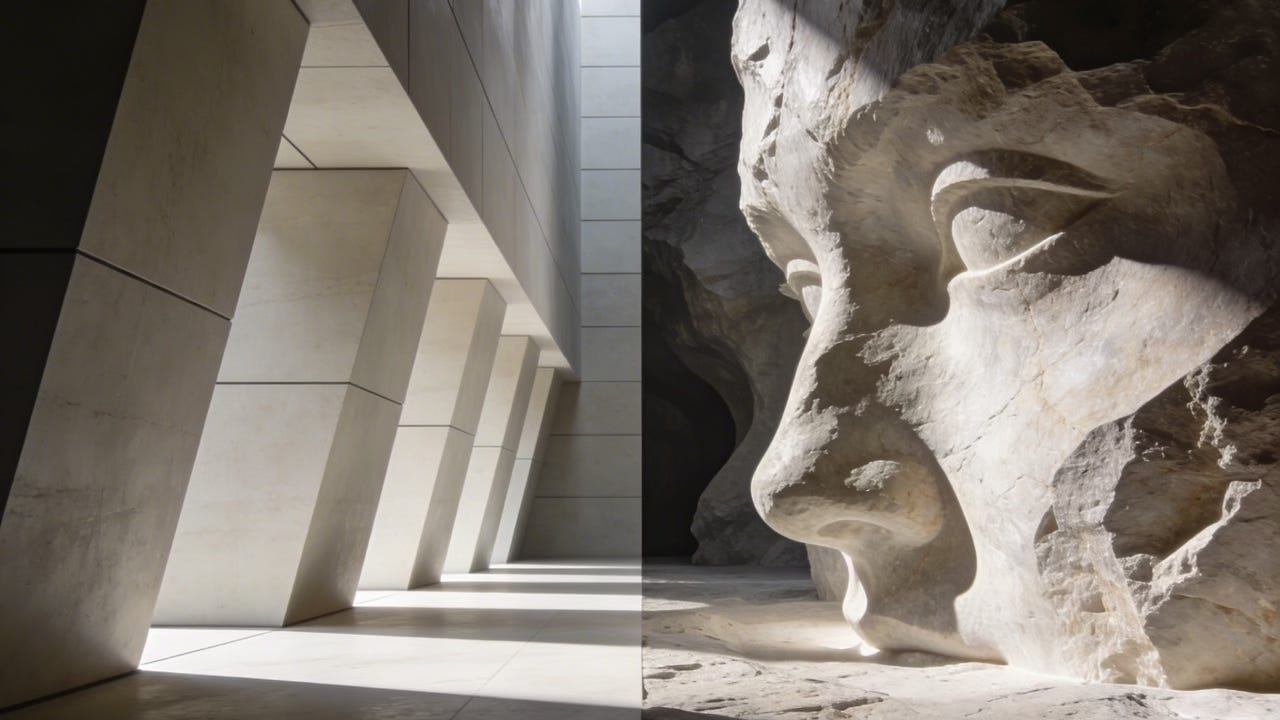
The sublime has never been only about novelty, polish, or technical complexity. It emerges when something exceeds mere function and touches a deeper register, scale, mystery, contradiction, silence, awe, terror, intimacy, memory, transcendence, truth. The sublime is not only a formal effect. It is an existential one. It is what happens when a work carries more charge than its utility can explain.
The deeper risk is not that AI kills creativity. The deeper risk is that we begin to mistake optimization for depth.
Tomorrow, the creative may struggle against excess of possibility and excess of optimization.
That risk becomes sharper when generation is paired with simulation. Once systems can produce endless options and also test those options inside increasingly rich world models, the pressure toward the plausible becomes even stronger. The plausible is easier to justify. Easier to validate. Easier to optimize. Easier to scale. It begins to accumulate the authority of both production and proof.
And yet simulation may also do something else. It may occasionally surface possibilities that exceed our default patterns.
That is where the conversation around AI and creativity becomes more interesting.
The question is no longer only whether machines can imitate human outputs. It is whether computational systems, through generation, search, and simulation, can begin to reveal forms, relationships, structures, or futures that feel creative to us precisely because they go beyond habit.
That does not make them human.
But it does mean that creativity itself becomes harder to define in simplistic terms.
We are already seeing early signs of this logic across culture. Songs can be engineered to fit statistically familiar patterns. Film and streaming content can be shaped through layers of audience data, retention logic, genre calibration, and algorithmic confidence. Visual content can be tuned toward immediate legibility. The result is often smooth, consumable, highly functional work that knows how to perform. But knowing how to perform is not the same as knowing how to matter.
This is where the junk food analogy becomes useful. Junk food is designed to satisfy quickly. It is optimized for craving, repetition, and immediate reward. It works. But it rarely nourishes. Culture can drift in the same direction. We can produce environments, images, systems, stories, music, and experiences that are frictionless, effective, emotionally legible, and perfectly packaged for consumption, yet still feel hollow.
Well performing, but shallow. Intelligent, but forgettable. Beautiful, but not necessary.
That is the danger.
Not simply that machines generate. Not simply that systems optimize. But that entire creative ecologies begin to drift toward what can be measured, predicted, defended, and repeated, while losing the tension, ambiguity, asymmetry, and risk that often give great work its charge.
The sublime has never lived comfortably inside fully optimized systems.
It often comes from tension, restraint, rupture, boldness, contradiction, silence, risk, and conviction. It often arrives through decisions that are hard to defend in purely instrumental terms, because they carry something less measurable and more fragile. They may not be the safest choice. They may not score highest in a simulation. They may not perform best in every model. But they are the choices that make work feel alive.
So maybe the creative of the future becomes not the person who competes with the machine on output, but the person who protects and directs what optimization tends to erase.
The one who can say: this is too smooth. This is too obvious. This is too efficient to be moving. This works, but it does not matter. This performs, but it does not live.
And then create something with deeper charge.
But there is another layer now.
If sufficiently advanced systems can generate, evaluate, and simulate at scale, then the creative is no longer only selecting among artifacts. They are increasingly choosing among futures. Among possible worlds. Among trajectories that can be rehearsed before they are built.
That raises the stakes of judgment.
Because once intelligence can participate not only in production, but in the exploration of possibility space, the creative task becomes more upstream. More architectural. Less about making one thing, more about defining the conditions under which things come into being.
If I had to reduce the argument to one sentence, it would be this:
The creative of the future is the person who can still create the sublime inside systems increasingly designed to produce the plausible.
Because when everything can be generated, the rare thing is no longer production. It is vision. Courage. Emotional accuracy. Moral and cultural judgment. Communication. The ability to frame an idea, tell a story, and move other people through it. The ability to know what should exist, and just as importantly, what should not.
And maybe that is where the sublime survives.
Not in resisting AI. Not in pretending authorship questions disappear. Not in romanticizing a past that is already gone.
But in ensuring that optimization never becomes our highest creative value, and that intelligence, however advanced, never replaces the deeper human task of making something that truly moves us.